Understanding why changes to lines charges may impact your electricity bill
From 1 April 2026, most households will see an increase in their electricity bills. Part of the cost for getting electricity to your home – through poles, wires and pylons – will increase.


What's happening?
It costs to move electricity across the country from where it is generated and deliver it to your home or business via transmission and distribution networks. Together, distribution and transmission costs make up just over 30% of the average power bill. These costs started rising in 2025 are likely to keep rising until at least 2030, which means that your bill will rise too.
We know that that any increase in household bills is tough. But these higher costs are needed to repair, replace and upgrade the electricity networks that keep your power on – now and in the future.
We also know that some of the other costs that make up your power bill might be increasing. For further information about possible changes to the generation or retail parts of your bill, see the Electricity Authority’s websiteopen_in_new or contact your retailer directly.
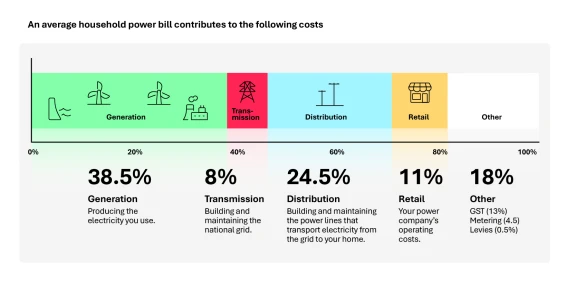
Why are distribution and transmission related costs increasing?
There are three key reasons for why the distribution and transmission component of your electricity bill is increasing:
- High inflation – Recent high inflation has led to significant increases to electricity lines companies’ costs.
- Interest rate increases – Similar to a fixed term mortgage, interest rates are fixed for a period of 5 years under our regulations. Interest rates are much higher now than when we last set these interest rates in 2019.
- Higher levels of investment – Transpower and local lines companies plan to spend more than they have previously to maintain the network and support growth. This is because assets built in the 1960s and 1970s need replacing, different resilience investments need to be considered in response to the increasing frequency of extreme weather such as Cyclone Gabrielle, and increased demand needs to be supported as New Zealand’s population grows and we rely more on electricity as we switch away from fossil fuels.
The exact impact on your bill varies by region and retailer, because each local network and retailer’s pricing is different. Another a key factor is population density.
You can find your local lines company using this interactive map from Electricity Networks Aotearoaopen_in_new.
What is the Commission doing to help with price rises?
The Commission is working to ensure you have a safe, reliable and resilient electricity network at a reasonable cost. To keep electricity network costs as low as possible, we review Transpower and most local lines company expenditure forecasts before deciding how much spending to allow. We also limit the rate at which Transpower and most local lines companies can increase prices each year.
You can learn more about the steps we took to limit the increases to lines charges on our website as well as in the English and Te Reo Māori videos below.
How can I find out how much my bill will increase?
For questions about your own bill, contact your electricity retailer – they’re best placed to explain which of the components of your bill are increasing as well as how much your overall bill will be increasing by.
Where to find more information
For information directly from your local lines company
Local lines companies – with revenue limits set by us
- Top Energyopen_in_new
- Vectoropen_in_new
- PowerCoopen_in_new
- Horizon Energyopen_in_new
- Firstlight Energyopen_in_new
- The Lines Companyopen_in_new
- Unison Networksopen_in_new
- Wellington Electricityopen_in_new
- Nelson Electricityopen_in_new
- Network Tasmanopen_in_new
- Orionopen_in_new
- Electricity Ashburtonopen_in_new
- Alpine Energyopen_in_new
- Aurora Energyopen_in_new
- OtagoNetopen_in_new
- Electricity Invercargillopen_in_new
Local lines companies – without revenue limits set by us (ie, consumer owned)
- Northpoweropen_in_new
- Counties Energyopen_in_new
- WEL Networksopen_in_new
- Waipa Networksopen_in_new
- Centralinesopen_in_new
- Scanpoweropen_in_new
- Electraopen_in_new
- Marlborough Linesopen_in_new
- Buller Electricityopen_in_new
- MainPoweropen_in_new
- Westpoweropen_in_new
- Network Waitakiopen_in_new
- The Power Companyopen_in_new
For information from Transpower
For information from the Electricity Authority
Energy Efficiency and Conservation Authority
The Energy Efficiency and Conservation Authority (ECCA) provides advice on using less energy. ECCA has practical energy-saving tips for around the home to save on costs on their websiteopen_in_new.
Electricity Retailers’ and Generators’ Association of New Zealand
The Electricity Retailers’ and Generators’ Association of New Zealand (ERGANZ) also provides some helpful information for those struggling with their power bills. Find out more on their websiteopen_in_new.
Citizens Advice Bureau
Your local Citizens Advice Bureau can help you if you’re having problems with your power bill and want to understand what your rights and options are visit their websiteopen_in_new or call 0800 367 222.