Aurora’s performance alongside the customised price-quality path – Year Four
This is our fourth fact sheet that provides our analysis and summary of how Aurora Energy is performing and delivering in its fourth year of its customised price-quality path (CPP).


Snapshot of Aurora's performance
March 2025
Purpose of this fact sheet
This fact sheet summarises how Aurora Energy Limited (Aurora) performed in the fourth year (ending March 2025) of its customised price-quality path (CPP).
Overview
Aurora is currently operating under a five-year CPP set by the Commission for the period from April 2021 to March 2026. This allows Aurora to recover up to $563 million from its customers to fund spending to address long-standing safety and reliability issues in its electricity network.
Aurora achieved the reliability and quality requirements that we set for the year ending March 2025 and stayed within the revenue limit we set.
What Aurora is doing well
- Improved asset management: Aurora has strengthened its asset management practices across multiple areas, including asset inspections, asset risk assessments, and the implementation of new asset management software systems. This helps it determine what is causing interruptions and other problems, and gives it a clearer picture of how safe equipment is and what could go wrong.
- Ongoing asset renewal: Aurora has continued to focus on replacing assets that could pose safety risks.
- Improved reliability: Aurora has improved the reliability of its network. The frequency of unplanned interruptions decreased by 32% and the duration of interruptions decreased by 34% in the last year.
- Improved low voltage monitoring: Aurora is making good progress in monitoring and identifying power quality issues, especially power quality issues caused by instances of low- voltage on its network. It has done this by using predictive modelling and adjusting transformers to improve performance.
- Ongoing customer engagement: Aurora met the requirements we set for it to engage with its communities. Aurora carried out a wide range of customer engagement initiatives, including newsletters, advertorials and public forums. These efforts are contributing to positive outcomes, as reflected in Aurora’s 2025 customer satisfaction survey, which shows improved perceptions of Aurora’s performance and increased customer confidence in the company.
- Faster complaint resolution: Aurora is now solving customer complaints much faster than it did in previous years. For example, in Dunedin, the average time to address a voltage quality complaint dropped from 53 days last year to just 2 days this year. Similarly, over the same period in the Central Otago and Wānaka region, the average time to address the same issue fell from 16 days to 2 days.
Areas for continued development
- Ongoing engagement with its community on new investments: Aurora will need to continue to engage effectively with its community about new developments to support system growth.
- Continuing to build a strong safety culture: Aurora experienced an increase in reported safety incidents this year. The rise was largely due to improved reporting practices among staff and incidents involving external parties. This reflects a positive shift toward a stronger safety culture, which Aurora should continue to foster and build upon.
What Aurora is investing in
Aurora completed several significant projects across its network. These projects improved the reliability and safety of the network and in some cases will support future growth.
- Completed projects in year ending March 2025:
- Frankton substation upgrade;
- Upper Clutha transformer replacement and protection scheme;
- Omakau new substation; and
- Smith Street to Willowbank Inter-tie (ring network) in Dunedin.
- Ongoing projects:
- Riverbank new transformer.
Specific aspects of performance
Quality and service reliability
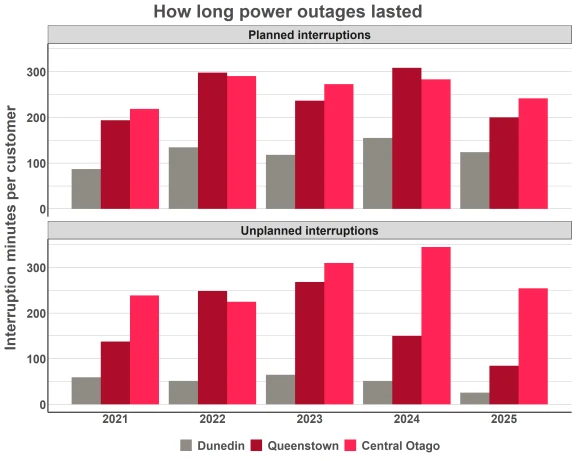
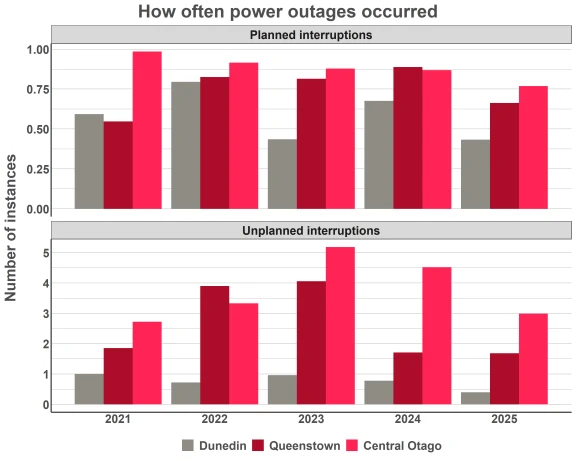
Aurora’s network reliability improved across all three subnetworks, with fewer and shorter planned and unplanned interruptions. This marks a reversal of the upward trend seen in earlier CPP years.
- All types of interruptions declined, especially those caused by overgrown vegetation and those with unknown causes.
- Reliability remained within the limits set by the CPP.1
Greater understanding of unknown causes of interruptions
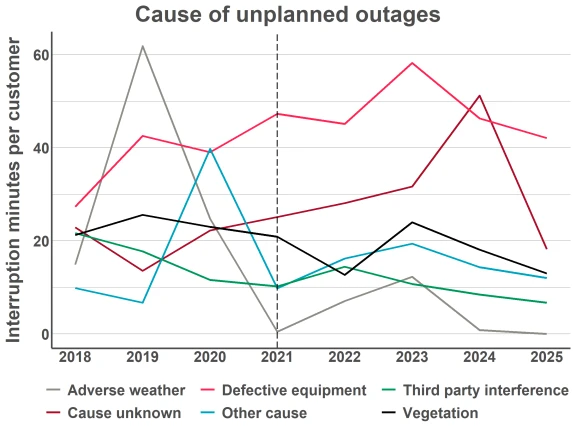
Last year we recommended Aurora improve its understanding of “unknown” causes of interruptions, since these had been increasing during the first three years of its CPP. This year the number of interruptions with unknown causes dropped significantly, as shown by the dark red line in the chart below. This improvement reflects Aurora’s efforts implementing new systems, conducting better fault reviews, and setting up a formal investigation process for faults.
Aurora remains strongly motivated to restore power promptly after power interruptions
The updated Aurora customer charter no longer offers customer compensation for delays in restoring power following unplanned interruptions. Despite this change, Aurora is still driven to restore power quickly due to performance standards set by the Commission and internal key performance indicators (KPIs) applied to Aurora’s contractors.
Expenditure
Aurora is still spending more on capital projects than originally planned in its CPP, even after adjusting for inflation. Operating costs also went up in the last year but are now in line with the forecast for the year. Despite these increases, Aurora remains within the overall revenue limit set for the 5-year CPP period.2
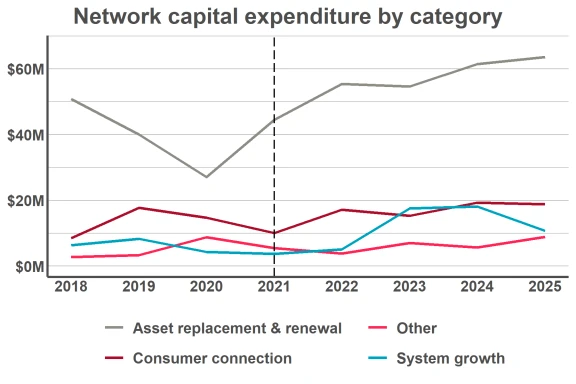
Aurora’s total expenditure in the year was $158.7 million, of which $63.5 million went toward replacing and renewing assets to address past underinvestment in its network. Since the start of the CPP, Aurora has spent 82% of its forecast budget on asset replacement and renewal, and appears to be on track in this area.
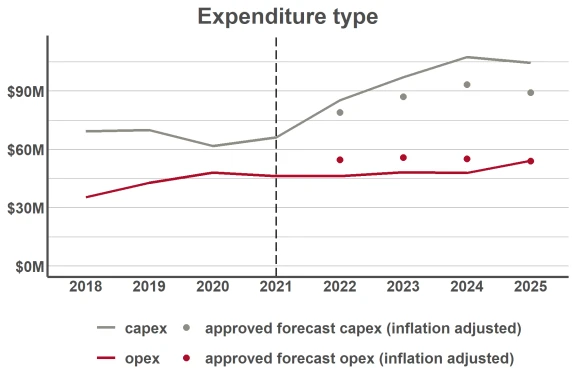
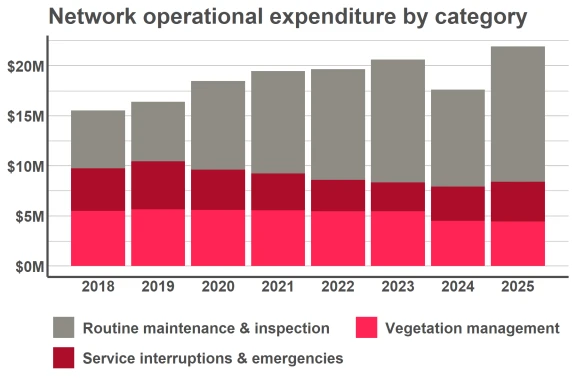
The chart above shows that in the last year Aurora spent less on capex but increased its opex up to its approved amount. The charts below show where the money was spent: most capex went to replacing and renewing assets, while most opex covered routine maintenance and inspection.
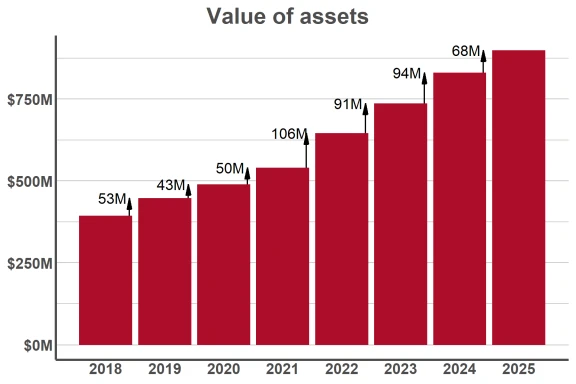
Aurora’s regulatory asset base (value of assets) increased by $68 million over the last year, and $358.4 million (66.4%) during the CPP period to date. The main components of these increases were newly commissioned assets and the upward revaluations of assets caused by higher-than-expected inflation.
Note
- Reliability is measured by System Average Interruption Duration Index (SAIDI) and System Average Interruption Frequency Index (SAIFI). SAIDI describes the average length of a power interruption for each customer over a year. SAIFI describes the average number of power interruptions a customer experiences over a year.
-
Capex (capital expenditure) is money spent to buy, improve, or maintain assets like power cables, poles, or information systems. These assets lose value over time, and the cost is spread across their useful life. Opex (operational expenditure) is the day-to-day cost of running the business, such as rent, utilities, and staff wages.